
Inside Arrow's ITAD Process: From Pickup to Certificate of Destruction
What Actually Happens to Your Retired IT Equipment?
Somewhere in your office, there's a closet, a storage room, or a stack of pallets holding retired laptops, servers, or hard drives that nobody quite knows what to do with. It feels harmless — until you remember what's stored on those drives: client records, financial data, employee files, patient information. Every piece of decommissioned IT equipment sitting in storage is a liability waiting to surface, and “we'll deal with it eventually” isn't a data security policy.
IT Asset Disposition (ITAD) exists to solve exactly this problem. But from the outside, “ITAD” can sound like a black box — equipment goes in, and a vague promise of “secure recycling” comes out. Here's what actually happens to your retired technology assets when you work with Arrow, step by step.
Step One: Pickup, Deinstallation & Inventory
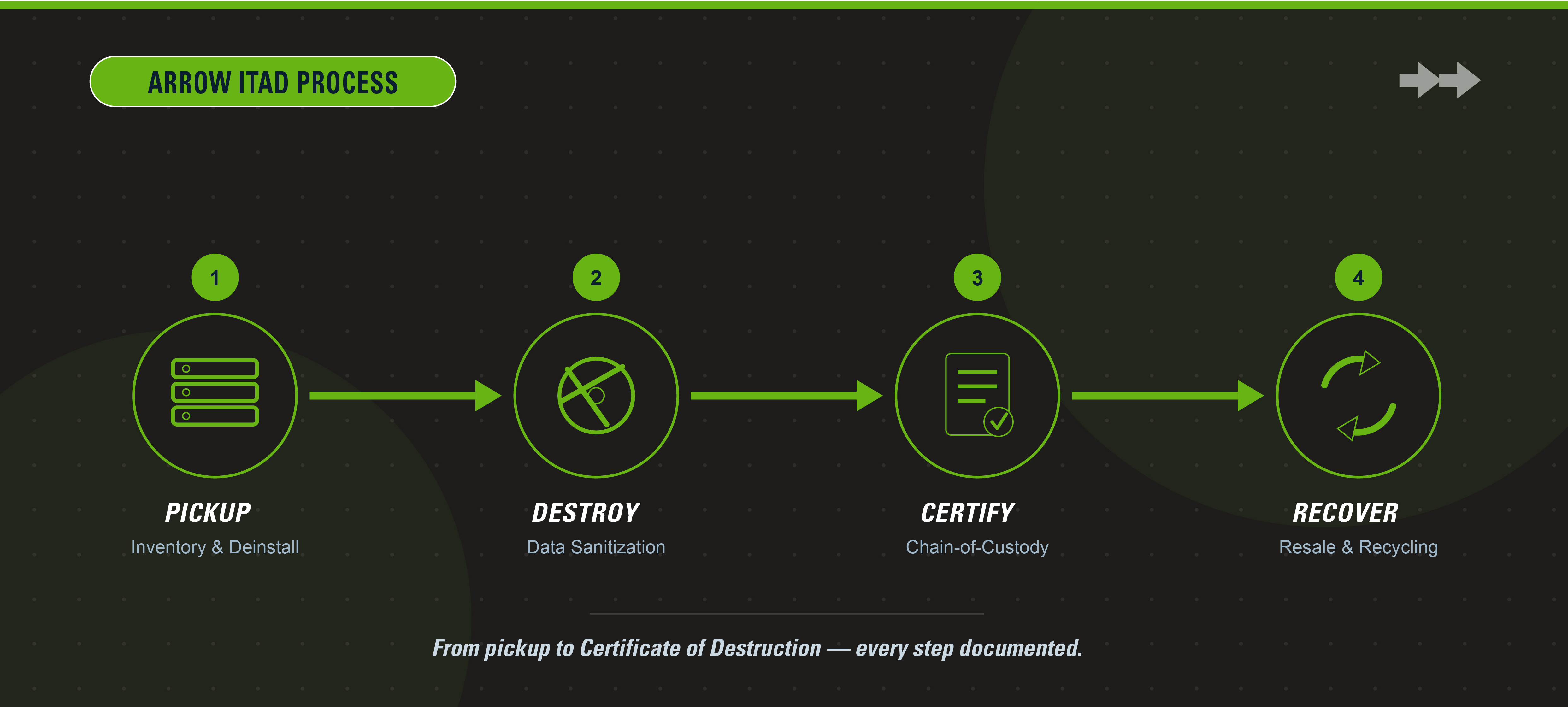
The process starts before a single device leaves your building. Depending on the scope of the project, Arrow's team can handle deinstallation on-site, removing servers, workstations, networking equipment, or other assets from racks and workspaces. As equipment is collected, it's logged — not just counted, but identified by serial number and asset type, creating a documented inventory before anything is transported. For organizations managing dozens or hundreds of assets across departments or locations, this step is what turns “we think we got everything” into a verifiable record. It's also the foundation for everything that follows — you can't issue an accurate Certificate of Destruction for a device that was never tracked in the first place.
Step Two: Data Sanitization & Physical Destruction
This is the step most people picture when they hear “data destruction,” and for good reason — it's where the actual risk gets eliminated. Depending on the device and the customer's requirements, this can mean data sanitization, physical destruction of hard drives and other storage media, or both, including on-site or mobile shredding for organizations that want to witness the process directly. Deleting files, reformatting a drive, or resetting a device to “factory settings” does not destroy the data on it — recoverable data can sit on a drive long after the recycle bin has been emptied. Certified destruction is built around that distinction. Whether it's a single hard drive or a few hundred units from a server room, the goal is the same: the data can't be recovered by anyone, at any point, after it leaves your hands.
Step Three: Documentation & Chain-of-Custody
Every step above is only as good as the paper trail behind it. As an R2 and RIOS certified facility, Arrow documents chain-of-custody from the moment an asset is picked up to the moment it's destroyed or recycled — tracking where it went, who handled it, and when. At the end of the process, customers receive a Certificate of Destruction tied to the specific assets processed. For IT directors, compliance officers, and facilities managers, this documentation isn't paperwork for paperwork's sake — it's the evidence your organization needs if you're ever asked to demonstrate how a retired asset was handled, whether that's for an internal audit, a vendor review, or a regulatory question.
Step Four: Resale, Refurbishment & Responsible Recycling
Not every retired asset ends its life in a shredder. Equipment that still has functional value may be eligible for resale or refurbishment, which can help offset the cost of an ITAD project and recover value from equipment your organization already paid for. Material with no resale value is responsibly recycled, with components and commodities recovered and processed in line with Arrow's Zero Landfill commitment. Value recovery potential depends on the age, condition, and type of equipment — not every asset has resale value, which is why an honest, case-by-case assessment matters more than a blanket promise.
The Bottom Line
ITAD isn't a single action — it's a sequence of safeguards, and the value is in the chain, not just the final step. Pickup and inventory create accountability. Sanitization and destruction eliminate risk. Documentation proves it happened. Resale and recycling close the loop responsibly.
If your organization has retired servers, laptops, hard drives, or other end-of-life technology sitting in storage, request an ITAD consultation or call Arrow at 631-319-1910 to talk through what a documented disposition process looks like for your equipment.